
Wilder Community Ranger John Attiwell shares a day at Tollesbury Wick, exploring its rich wildlife and the people who value it.
On a Friday in late April 2026, as late spring shifted into early summer, I was out again participating in Essex Wildlife Trust’ strand of the BUDS in the Blackwater Estuary project: public engagement. With the sun shining, I headed to Tollesbury Wick nature reserve, one of several important wildlife sites that will benefit from the planned work.
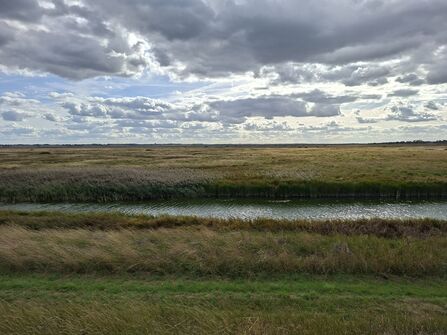
Sitting downriver of Maldon, across the Blackwater from the leisure-sailing community of Bradwell, Tollesbury Wick is a magnificent expanse of coastal grazing marsh. Meadow-nesting waders are now benefiting from predator-proof fencing, while Red Poll cattle graze quietly across the site. A pair of lapwings, now scarce in the wider countryside but still thriving on reserves like Tollesbury Wick and RSPB Old Hall Marshes, were performing their noisy, acrobatic display flights, chasing off passing corvids and raptors. A sure sign they are breeding or at least planning to.
A hobby swept in off the Blackwater, flying low over my head before heading out across the marsh. These summer-visiting falcons specialise in hunting dragonflies, which thrive in Essex’s grazing marshes.
The grazing marshes of the Essex Rivers, and similar sites across the Thames in Kent, are entirely artificial in origin. They were created over centuries as sea walls were built and land was reclaimed from the river. Aerial imagery still reveals the winding paths of once-tidal creeks, some now dry, others filled with fresh water and supporting abundant wildlife. These habitats depend on strong sea defences to protect what has, somewhat inadvertently, become a haven for wildlife.
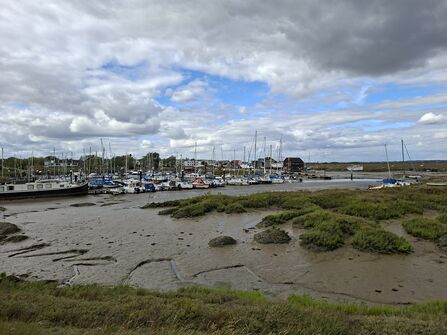
I stopped to chat with a local resident living in one of the flats overlooking the marina. She spoke warmly about the area and made it clear that this landscape still holds deep value for the community. Its protection matters.
Continuing my walk towards the point, I passed the Tollesbury lightship, now home to a Christian sailing charity, and the mix of cruisers and dinghies dotted across the saltings. Some were clearly well used; others, perhaps best described as “between restorations,” hosted noisy pairs of black-and-white, carrot-billed oystercatchers. Nearby, a few lingering brent geese rested alongside white shelducks on the glossy mud of the Blackwater. Soon, these small, dark geese will begin their migration back to western Russia, where they breed near St Petersburg. Swallows darted overhead, newly returned from Africa, taking advantage of the rich insect life of the marsh.
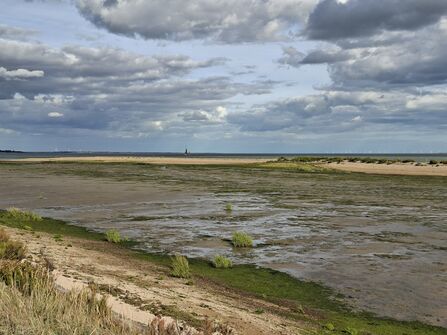
At Tollesbury Point, with wide views across the estuary towards Bradwell-on-Sea, I paused. The calm grey water reflected the sunshine, with the marina and the shell of the decommissioned Bradwell Power Station visible beyond. Common terns overhead.
Here, I spoke with a visitor from Kent, who reflected on how the Essex coast feels less pressured by tourism than parts of his local coastline. He wished us well in the project. I took a moment to reflect too.
The shingle islands here, set to be recharged and extended as part of the BUDS in the Blackwater Estuary project, could once again provide breeding habitat for little terns. These birds still occur in the wider estuary but once nestled here, when the shingle was fresh and sparsely vegetated. It would be wonderful to see their return.
Having worked with little terns in the north of England, I know how vulnerable they can be. High tides, disturbance and predation can easily lead to breeding failure. They need, undisturbed, open shingle that remains above the highest tides. The work planned here could help provide exactly that.
As I wandered back to my car at Woodrolfe Road, a peregrine, all speed and focus, prey dangling from yellow talons, flashed along the sea wall at head height. Above the marsh, a marsh harrier quartered the reeds, while a lesser whitethroat sang from a nearby bush.
This is a remarkable place, one of several that will benefit from the BUDS in the Blackwater Estuary project. It is a landscape rich in wildlife and deeply valued by people, and one that deserves protection for generations to come.
The BUDS in the Blackwater Estuary project is led by the RSPB, with Essex Wildlife Trust and Harwich Haven Authority as partners. Funding comes from the Environment Agency/Defra NFM programme and the Zoological Society of London-led Transforming the Thames project, funded by the Endangered Landscapes & Seascapes Programme and managed by the Cambridge Conservation Initiative in partnership with Arcadia.
- Written by John Attiwell